2026
Sri Lanka: yearly mundane forecast
The year
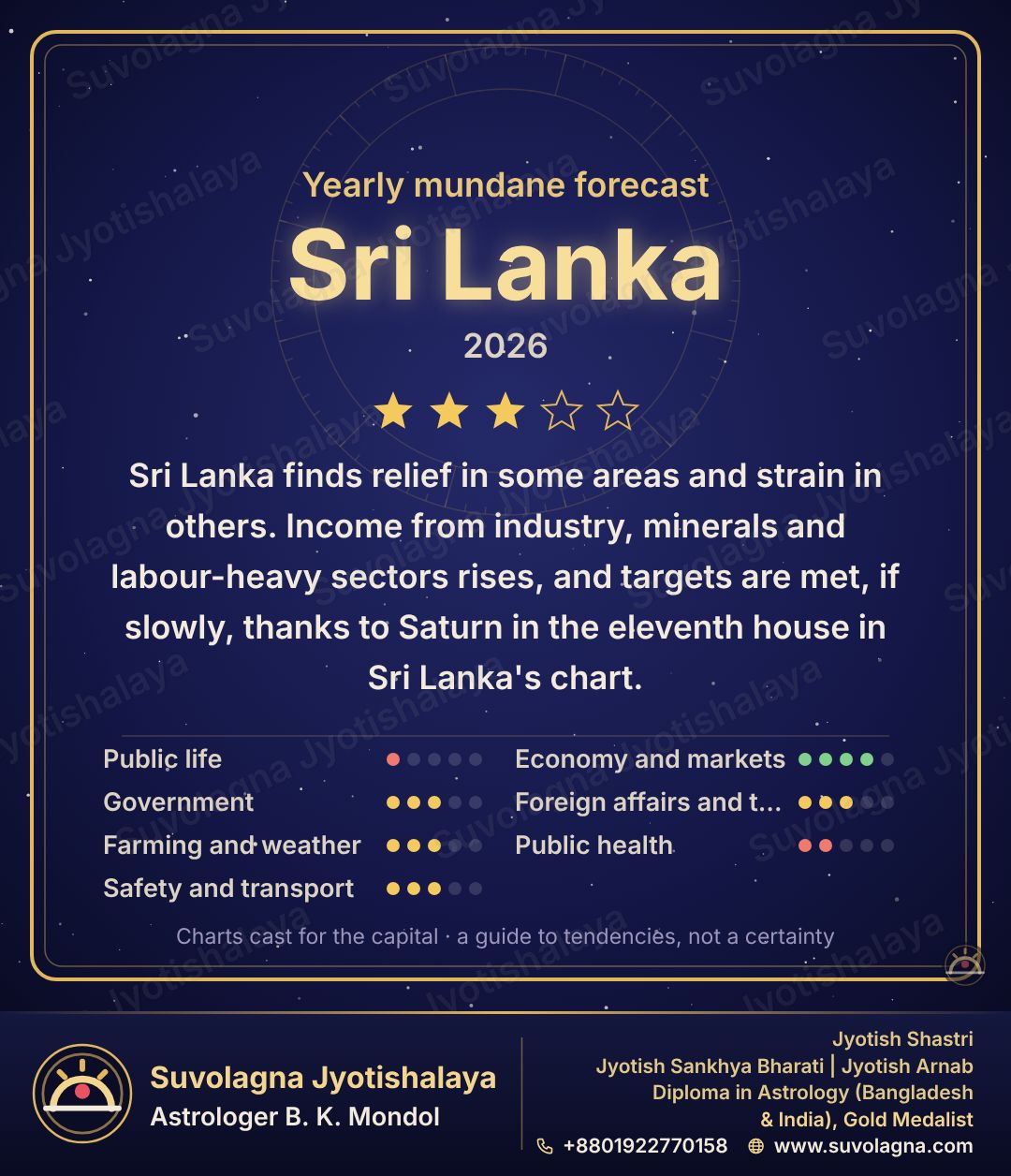
Sri Lanka finds relief in some areas and strain in others. Income from industry, minerals and labour-heavy sectors rises, and targets are met, if slowly, thanks to Saturn in the eleventh house in Sri Lanka's chart. But with the Sun in the twelfth house in Sri Lanka's chart, public spending rises and weak spots inside the administration may come out.
The chart of the year
The astrological year begins when the Sun enters sidereal Aries (Mesha Sankranti), this year on 14 April 2026 (Tuesday), 9:38 am, local time. At that moment Taurus was rising over Colombo. It is a fixed sign, so this chart is taken to hold for the whole year.
- Rahu in the tenth house means opacity, scandal or unexpected reshuffles in government are possible, and the balance of power may wobble.
- With Jupiter in the second house, the treasury and savings gain strength, and confidence in banks and finance returns.
- With Saturn in the eleventh house, income from industry, minerals and labour-heavy sectors rises, and targets are met, if slowly.
- Mars in the eleventh house means income from industry, construction and defence rises, and even hard targets may be met.
- The chart’s ruler is Venus: the ruler is in the twelfth house, so watch spending, money leaving the country and hidden problems.
Area by area
Public life ★☆☆☆☆
Unrest and anger run strong; restraint is needed wherever crowds gather. Main factor: Ketu in the fourth house.
Economy and markets ★★★★☆
Markets are lively and trade picks up. Main factor: Jupiter in the second house.
Government ★★★☆☆
The administration goes at its own pace: some success, some controversy.
Foreign affairs and trade ★★★☆☆
Mixed results in diplomacy: closer with some, cooler with others.
Farming and weather ★★★☆☆
The weather stays fairly normal.
Public health ★★☆☆☆
Health services are stretched; the old and the young need extra care. Main factor: the Sun in the twelfth house.
Safety and transport ★★★☆☆
No big risk, but following the rules is wise.
Quarter by quarter
- January to March ★★★☆☆ (Capricorn ingress (Makar Sankranti), Taurus rising): The treasury and savings gain strength, and confidence in banks and finance returns (Jupiter in the second house); but opacity, scandal or unexpected reshuffles in government are possible, and the balance of power may wobble (Rahu in the tenth house).
- April to June ★★☆☆☆ (Aries ingress (Mesha Sankranti), Taurus rising): The treasury and savings gain strength, and confidence in banks and finance returns (Jupiter in the second house); but opacity, scandal or unexpected reshuffles in government are possible, and the balance of power may wobble (Rahu in the tenth house).
- July to September ★★★☆☆ (Cancer ingress (Karkat Sankranti), Pisces rising): Big steps in education, research and youth welfare are possible, with good news on child health (Jupiter in the fifth house); but work moves slowly and people sound tired and gloomy (Saturn in the first house).
- October to December ★★☆☆☆ (Libra ingress (Tula Sankranti), Taurus rising): Income from industry, minerals and labour-heavy sectors rises, and targets are met, if slowly (Saturn in the eleventh house); but opacity, scandal or unexpected reshuffles in government are possible, and the balance of power may wobble (Rahu in the tenth house).
Eclipses this year
- 17 February 2026 (Tuesday): annular solar eclipse in Aquarius, Dhanishtha. Not visible from Colombo, so by tradition its effect here is mild and no sutak applies.
- 3 March 2026 (Tuesday): total lunar eclipse in Leo, Purva Phalguni. Visible from Colombo (about 3:19 pm to 6:47 pm). It falls in the fourth house, so farming, land and housing need care in the weeks around it.
- 12 August 2026 (Wednesday): total solar eclipse in Cancer, Ashlesha. Not visible from Colombo, so by tradition its effect here is mild and no sutak applies.
- 28 August 2026 (Friday): partial lunar eclipse in Aquarius, Shatabhisha. Not visible from Colombo, so by tradition its effect here is mild and no sutak applies.
Moves of the slow planets
- 11 March (Wednesday): Jupiter turns direct; stalled work on the economy and food supply gets moving again.
- 2 June (Tuesday): Jupiter moves into Cancer (the third house here); things shift in transport, media and neighbours.
- 27 July (Monday): Saturn turns retrograde in Pisces; decisions on revenue, income and parliament may slip and old issues return.
- 31 October (Saturday): Jupiter moves into Leo (the fourth house here); things improve in farming, land and housing.
- 12 November (Thursday): Jupiter and Ketu meet in Leo (the fourth house here); a steadying hand on farming, land and housing.
- 5 December (Saturday): Rahu moves into Capricorn (the ninth house here); pressure builds in the courts, religion and higher education.
- 11 December (Friday): Saturn turns direct; stalled work on revenue, income and parliament gets moving again.
- 13 December (Sunday): Jupiter turns retrograde in Leo; decisions on farming, land and housing may slip and old issues return.
The nine officers of the year (navanayaka)
By panjika custom each year gets a king, a minister and seven other officers from the weekdays of key moments: the king from the weekday of Chaitra Shukla Pratipada (19 March 2026), the minister from the weekday of Mesha Sankranti, and so on. These classical results describe the season and the land, not individuals.
| Office | Planet | Traditional reading |
|---|---|---|
| King | Jupiter | Religion and justice are honoured, and people stay healthy and content. |
| Minister | Mars | Fires in towns, villages and forests, scant rain, and quarrels among rulers. |
| Commander | The Moon | Heavy rain and high prices, but people stay free of disease. |
| Lord of monsoon crops | Jupiter | Barley, wheat and gram do well. |
| Lord of winter grain | Mercury | Moderate rain and low yields. |
| Lord of rain | The Moon | Good rain across the land and good crops. |
| Lord of prices | The Moon | Good rain and crops, though prices are high. |
| Lord of liquids | Saturn | Oil, ghee and other goods get dearer. |
| Lord of metals | Jupiter | Gems, gold, betel nut and sandalwood are easy to find. |
Chart details (for astrologers)
Mesha Sankranti: 14 April 2026 (Tuesday), 9:39 am local time in Colombo. Ascendant Taurus 24°22′.
| Planet | Sign | Degree | House | State |
|---|---|---|---|---|
| Sun | Aries | 0°00′ | 12 | exalted |
| Moon | Aquarius | 16°22′ | 10 | |
| Mars | Pisces | 9°09′ | 11 | |
| Mercury | Pisces | 4°25′ | 11 | debilitated |
| Jupiter | Gemini | 22°38′ | 2 | |
| Venus | Aries | 23°34′ | 12 | |
| Saturn | Pisces | 12°56′ | 11 | |
| Rahu | Aquarius | 12°28′ | 10 | |
| Ketu | Leo | 12°28′ | 4 |
How this is worked out: The year is read from the Mesha Sankranti chart, with the four cardinal sankrantis for the quarters, plus the year’s eclipses and the movements of Jupiter, Saturn and Rahu. Charts are cast for Colombo in sidereal (Lahiri) positions with whole-sign houses. House meanings follow classical mundane astrology: the first house is the people, the tenth the government, the seventh foreign affairs, the fourth land and farming, the eighth disasters and debt. Astrology describes tendencies, not certainties.
Other countries
Common questions
Which chart is used for Sri Lanka?
Charts cast for the capital, Colombo, at the sankranti and new-moon moments, in Lahiri sidereal positions. This is the classical mundane method; no disputed national birth chart is used.
Is this certain?
No. Mundane astrology shows the tendencies of a period and where pressure or support is stronger. It does not predict specific events or the fate of any person.
Mundane astrology speaks of tendencies, not certainties. Please do not read it as a specific claim about any country, party or person.